
Dobro Master Jerry Douglas Talks Tone, Phrasing, and the Importance of Listening
The 16-time Grammy winner revisits his classic songs with a fresh perspective and a cohesive, road-seasoned band on ‘The Set.’

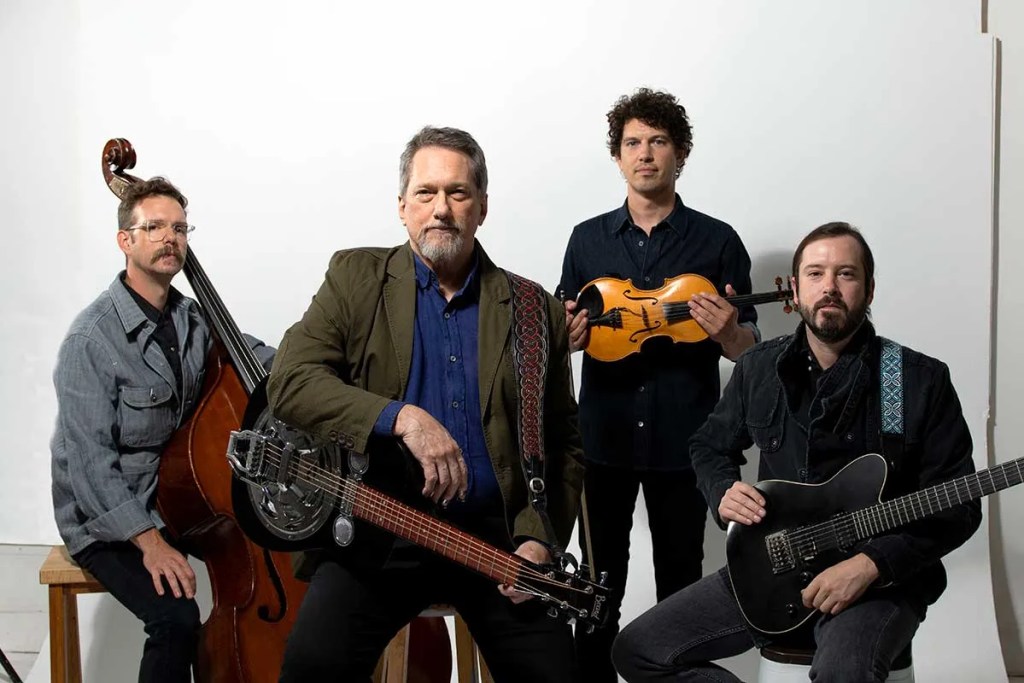
With a slide in his hand, 16-time Grammy winner Jerry Douglas has one of the most distinctive and yet adaptable voices in the business. Whether he’s playing with Alison Krauss and Union Station, or the Earls of Leicester, or working as a producer and master session player, Douglas can make a dobro or lap steel sing. But it’s as a solo artist with his longtime ensemble of Christian Sedelmyer (violin), Daniel Kimbro (bass), and Mike Seal (guitar) where Douglas and his slide can sing their own tune.
Although his latest release is a studio album, its title, The Set, is apt. Think of it as a fresh take on the career retrospective, drawing many of its songs from fan favorites in the band’s show. In that way, it flips the script from the studio-to-live-album trajectory. While live records often seem like best-of compilations by giving studio tracks an update and a crowd reaction track, The Set captures a touring band at the height of its powers in the studio for the first time since 2017.
The beautifully recorded tracks let the interplay come through like a conversation where everyone understands every word being said. But the collection goes beyond reinterpretations of old favorites. Thanks to the band’s cohesion, Douglas classics like “From Ankara to Izmir” (originally recorded in 1987) slot in nicely with relatively recent additions to the repertoire, like his sweeping cover of “While My Guitar Gently Weeps,” compositions by his three bandmates, and a concerto called “The Fifth Season” that Douglas says is designed to contain a few surprises.
I caught up with Douglas over the phone last fall, where he opened up about tone, phrasing, gear, and the importance of listening.
How did you choose the songs for The Set?
I kept having people come up to me after concerts, saying, “What was the third song you did in the first set? Where can I find that?” And I’d go, “Well, that’s on a Rounder record or Sugar Hill or Concord or Koch”—all these different labels I’ve been on. The recorded songs people are asking for are scattered over four different companies.
Also, if they went and got the songs they wanted to hear, they wouldn’t sound the same as live because there’s a different band and a completely different mindset on the song. When you record a song for the first time, no matter how good it is, it’s not going to stay that way. It’s going to morph into something else, and that’s what’s happened to all these songs.
So I chose a couple of songs that I had from way back that we do completely differently. I love the sound of this particular band playing these songs because we’ve been out there on the road playing them.
Why did you elect to go without drums?
We used to have drums all the time, but after I produced the John Hiatt record [Leftover Feelings, 2022], we haven’t used drums since—and there’s all this space.
Are you referencing the original versions of the songs, or are these live-tested arrangements different?
ADVERTISEMENT
I’m changing the version. Take “From Ankara to Ismir” on the new record: I originally cut that with a lap steel, trying to make it a tougher kind of song. But as I’ve been playing it over the years on dobro, it’s just taken on a different color, a different feel. Many of the songs, as I’ve played them and fleshed them out, I found countermelodies, added to them, and just changed all the parts.
How has the current band influenced the arrangements?
When you change the players, you’re going to get a different interpretation of the melody. But I don’t think I’m taking away anything. I think these versions are better because they’re more thought out. And I just like the sound of this band better, too. It’s not all over the place—it’s not a whole bunch of different instruments coming and going. It’s a band record. The only extra person is Aoife O’Donovan [adding vocals to the Mike Stern composition “What Might Have Been”].
The dynamic interplay between the solos and backing really comes across—it’s way more conversational than trading choruses.
Yeah, that’s Mike [Seal]. He’s very supportive. He’s really good at not giving the farm away behind me. He’ll voice a chord a different way, and it’ll just send you in a different direction. He’s really wonderful musician. And all these guys are like that. We’re not trying to pass the baton and not trying to overplay or outplay each other.
Has playing in a quartet without drums influenced your own playing?
I’m taking on more of a rhythm guitar role than I would normally in any other band. I find that I play less behind everybody. All I’m thinking about while they’re playing is supporting them, reacting to whatever they do. A lot of times I’ll play a line first, then they’ll play the line in their solo. We really listen to each other.
If you’ve got a great drummer, there’s just less space. You can’t hear everybody else as well because the tonal spectrum is full, so you have to fight for frequencies. We’re not fighting for anything. We’re all spread out in the sonic spectrum, so there’s less clutter.
What inspired the concerto “The Fifth Season”?
I got a commission from FreshGrass [festival in Massachusetts], and they go, “You can write your own concerto, or you can write a piece to a silent film.” I started working on it, got a couple parts, and then I just thought, “This needs to get weird.”
So I called Mike Seal, and we started changing a note here and there just to make it like, whoa—why’d it do that? We started building the parts and figuring out how they went together. When we got in the studio, we started shifting things around. Everybody was involved in it, but it was Mike and me on the front end. We filled in the blanks and made the tunes go different places. What I was trying for wasn’t “Let us impress you with our chops” but “Let’s make something nice that flows together and is demanding and challenging without going too far. Let’s be able to play it.”
Your album cover features a painting, and you’re known for your ability to add color tonally and through phrasing. Is that conscious or instinctual?
It’s instinctual. Phrasing has a lot to do with the situation. Take Alison Krauss. The way she phrases is really straight, and I might float something backwards and drag a few notes just to kind of stay there a little bit longer but not wreck the feel she’s set up—just putting the notes in certain places, not exactly where you would expect them.
Phrasing is so important; it maintains the feel. If you’re just firing bullets—if it’s just rapid fire—that’s one thing, but there’s so many things that we do that are really like, “OK, we need some purple over here,” or, “Things have gotten dark—bring it back to light again.” You shift from one palette to another.
With a slide, you can sustain. If I’m playing with Alison, I can ghost her vocal, and it’ll sound like a harmony part—but nobody’s singing. I really get off on that. That’s the most exciting part about all of this to me at this point is just reacting to things that are going on around me.
Do you listen differently today than you did as a young musician?
ADVERTISEMENT
I’ve always listened, but I don’t think I ever listened as closely as I do now. I think I’ve learned over time that that is what makes it cohesive. Is everybody playing in the same genre at the same time? I’ve heard guys take a bebop solo in the middle of something. It’s just like, “Dude, I know you can do that, but you didn’t have to do it right now—you just blew us up.” You’ve got to be careful with these songs. They’re delicate things, and with the wrong stuff going on behind them, it just negates the importance of what’s being said.
Your version of “While My Guitar Gently Weeps” is getting a lot of attention. Have you been playing it for a long time?
I haven’t. One day in rehearsal we were working out new songs, and I just started playing it. I wasn’t thinking about adding it to the set, but it was a perfect fit for dobro. It’s in A minor, and I’m just pulling off my second string. I can create this sort of minor feel right from the front, and that whole thing lays just so well on dobro. But you know, then you want to create your own melody; you want to move the song through some paces. I thought, “Why have I never played this before?”
Are you exclusively using your Paul Beard signature models?
I’m playing only them when I go out. I love mahogany guitars. I just think it’s the greatest tone. I chose the wood. I asked Paul Beard to build me a guitar that’s black and has a red fingerboard. He said, “Nobody will want that.”
I said, “Just build me one and let me see it.” And about that time the Hipshot came along too [see What He Plays sidebar]. About a year later, we started putting Hipshots on them—and that’s the only guitar he was selling for a long time. It did work. Everybody did like that guitar. They’re all over the place.
The Beard doesn’t have a tone ring inside of it like dobros. It has sound posts—like a violin—in different places inside to take the sound from the top to the bottom, evenly distributed through the guitar. And there are some baffles close to the top of where the cover plate is, which have the sides open so sound can move into the top of the guitar. In dobros, that’s where the bass is—under the screens. It’s not in the big part in the back, which gives off more high end. The farther you go toward the tailpiece, the more high end you pick up.
If I’m looking straight down at the guitar, where the neck joins the body and hits the cover plate, that’s noon. I’m trying to put the microphone at two o’clock, so I’m getting the best of both worlds.
I started pulling the screens out of my guitar when I was in the studio so I could get more bass—because screens compress the sound back down into the guitar a little bit. It’s not quite as bassy. If you pull those screens, you’ve got a wider tonal spectrum to choose from. If the miked sound is too bassy in that position, I might slide more back toward the cover plate to get more high end.

How do you create your tone?
I have this sound that I want to make. I’ll start out warming up on just one note, search all over the place and find myself a really juicy note, and then build everything around that for the rest of the evening. I just try to stay in that zone. It depends on what band I’m playing with, too. If I’m playing in a band that’s got drums, I’ll play more high-end stuff because the low, beautiful stuff won’t be heard. But the smaller the band gets, the more acoustic the band gets, the more I’m going for a really nice tone.
I want to feel that. I want to feel the tone in the strap of the guitar. Some instruments you’ll pick up and you can feel the tone moving through everything that’s connected to it. These Beard guitars were the first time I ever felt that. I felt the guitar going into my back, even going into my shoulder, all the way down. And, boy, that’s important. It just to keeps you in close touch with the instrument—being able to feel that warmth and power. Especially moving down the fifth, fourth, or sixth string, going for a real big, deep slide.
ADVERTISEMENT
How would you advise a player looking to improve their slide tone?
I try to not play a string that I’m not using. [Late dobro player] Mike Auldridge once told me one of the coolest things: If you’re not playing the first two strings, pull your bar off of them, because you’re transmitting energy into those strings that’s not needed. You’re robbing tone from somewhere else to throw it over where you’re not going to use it.
I’m really going for tone with every note. But there are times to be sloppy. I’ve studied my whole life to try to be as clean as possible—but you have to know when it’s OK to let up on that, just go crazy and be a percussive instrument at the same time.
How much pressure do you use on the slide hand?
I wish you could accurately measure that in foot-pounds. I put enough on it to not push the string out of tune. I don’t look at the neck as much as I used to, just because of muscle memory. But you should be able to see the front edge of the bar’s bottom lined up with the fret, and use just enough pressure so there’s no string rattle.
How about your right hand?
You’ve got multiple things to do with your right hand. My palm is always muting. But a lot of things I do, I don’t notice.
When I was learning to play, there was nobody to show me anything. It was like learning a foreign language and then going to that country and speaking it, and somebody understands you. That was a big moment—just to play something for [resonator guitar pioneer] Josh Graves. And he said, “Yeah, that’s right.” I said, “Oh, man, you’re kidding. I have no idea how to do this. I just listen to the records, look for the tones, and try to figure out where everything is coming from.”
ADVERTISEMENT
What He Plays
Onstage, Jerry Douglas plays the prototype of his Beard Guitars signature model. He uses a Beard 2010 steel bar and D’Addario EJ42 Resophonic strings with custom heavier gauges of .16 , .18, and .28 on the top strings.
His Beard has a Hipshot DoubleShot that changes the tuning from the standard dobro G B D G B D to open D (D A D F# A D,) with the flip of a lever. To facilitate the retuning of the strings, the guitar has Hipshot’s Roller Nut. “You don’t want to get caught up in friction,” he says. “They all move, and they come right back in tune. It’s great. I only have to bring one guitar to most shows.”
The Beard guitar has a Fishman Nashville bridge pickup, and Douglas worked with Larry Fishman to create a signature Aura pedal that models its acoustic sound. Working with famed Nashville engineer Bil VornDick, Douglas recalls, “We recorded 16 different mics at different distances—six inches, eight inches, and 20 inches—and Larry [Fishman] used modeling software to work with the pickup to emulate those mic sounds. It’s given me the dobro sound back.”
Onstage, he has been playing through an AER Compact 60 amp. “Tommy Emmanuel got me into those,” Douglas says. “They’re just amazing-sounding amplifiers.”
—EM

This article originally appeared in the March/April 2025 issue of Acoustic Guitar magazine.




Very interesting and informative interview, but the D tuning should be DADF#AD, not DAF#DAD.
Thanks for catching that!