

How To Build Your Own Fingerstyle Arrangements
In this lesson, we’ll look at how to build an arrangement of a melody from the ground up by working on the traditional tune “Greensleeves.”

In this lesson, we’ll look at how to build an arrangement of a melody from the ground up by working on the traditional tune “Greensleeves.”

In this lesson you'll learn how to sing and play a whole song with any set of strum patterns you like.
ADVERTISEMENT

Cash played the original version - which features just three chords - with a capo on the first fret.

As guitarist Scotty Moore tells it, the song’s recording happened nearly by accident.

McCartney’s unusual fingerpick-and-strum technique gives “Blackbird” its distinctive sound.
ADVERTISEMENT

“Big Yellow Taxi” was the sole single from Joni Mitchell’s 1970 album, Ladies of the Canyon. Though it didn’t crack the Top 40 (it charted at No. 67 on the Billboard singles chart), that doesn’t accurately reflect its success.

The goal of good fingerpicking accompaniment is to support the song you’re playing the best you can. Short fills between vocal lines, like the one in Example 9, can be a nice contrast to straight pattern picking.
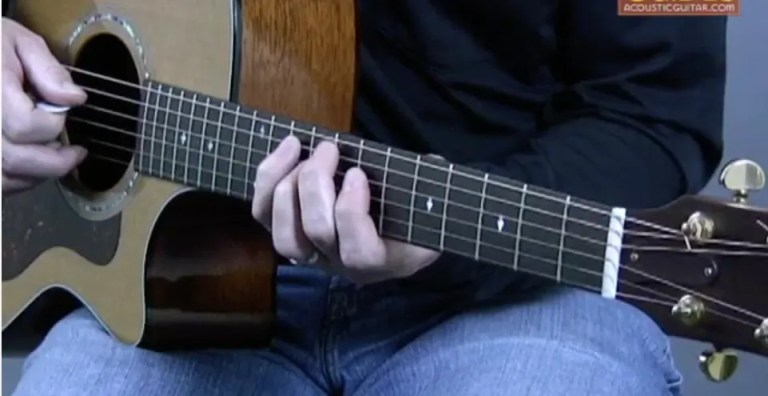
Like pentatonic scales, the patterns that make up major and minor scales can be found and repeated all over the fretboard.
ADVERTISEMENT

Here’s another way to use monotonic-bass picking. Try plucking a bass note with the thumb followed by three eighth notes in the fingers.

Some modern rock and pop tunes get a boost by injecting a laid-back groove with a 16th-note swing feel.

The so-called Bo Diddley beat, shown in Example 5a may seem difficult at first, but if you break the beat down into a 16th-note subdivision, you’ll find a 3–3–2 pattern in the first half of the measure that may help you get a handle on it.
ADVERTISEMENT

Finding a chord progression’s parallel major or minor key is easy: simply take the letter name of the original key and then flip it to major or minor.
A cousin of alternating-bass fingerpicking, monotonic-bass fingerpicking keeps your thumb on the same bass note, instead of alternating between two or three notes.
John Lennon added an interesting twist in the Beatles’ “Julia” by playing the same bass strings in the same order for each chord, regardless of which string held the root.

Most guitarists start playing leads by learning to play scales. This is a great way to begin, but scales are just one way to play solo lines. Learn more with this excerpt from Acoustic Rock Basics.
ADVERTISEMENT
This pattern lifted from bluegrass boom-chuck rhythm alternates bass notes with strums, as shown in Ex. 2a. You can mix bass notes and strum patterns in many ways.

Strum through this pattern on one chord, and you can hear the verse rhythm behind the Strokes’ “Last Night,” the rhythm pattern behind Hall and Oates’s “Maneater,” or the recurring anthemic rhythm in the Doors’ “Touch Me.”
The steady eighth-note pattern is about as simple as they come, but it’s the consistent use of downstrokes that gives this rhythm pattern its character.
ADVERTISEMENT
Drop-D tuning has been popular among many influential folk and Celtic players

Learn to deconstruct simple chord shapes and progressions to create classic-sounding riffs with this lesson in the Acoustic Rock Basics series from Acoustic Guitar.

One great way to use the flatted fifth is to approach it from below, ascending from the fourth.
ADVERTISEMENT

Learn to adapt the country boom-chuck rhythm to rock songs.

Sometimes, you only need a simple trick to create the right feel, and that’s the key to the groove in Example 1a.
Example 6a shows a syncopated rhythm that has become a staple of classic rock, modern rock, and pop.
ADVERTISEMENT
Some modern rock and pop tunes get a boost by injecting a laid-back groove with a 16th-note swing feel. Example 7a shows one common syncopated groove you can get with this feel, and Example 7b shows how you might embellish it to sound similar to Train’s hit “Drops of Jupiter.”

