

Blues Soloing Basics: Learn to Improvise on the 12-Bar Minor Pentatonic Scale
Understanding these few simple ideas will help make your blues playing more satisfying and musical.

Understanding these few simple ideas will help make your blues playing more satisfying and musical.

In this lesson you’ll learn a handful of essential barre chord shapes and use them to play the swing favorite “After You’ve Gone.”
ADVERTISEMENT
Learn how to use the form of the 12-bar blues as a roadmap for your improvising and give your blues solo a sense of logic and musical development.

Learn to create a solo that has a certain kind of connectedness and unity, because it’s based around some related ideas instead of just whatever lick you happen to come up with at the moment.

In this guitar lesson you will learn to play a 12-bar walking-bass blues in the key of E major, adding some swing to your blues playing.
ADVERTISEMENT
Space can be good, but if you want to create a bigger sense of dimension, adding in chords as responses to single-note licks can give you a new depth and texture, while creating an additional level of call-and-response.

Look at how to play into the downbeat to create momentum in your fingerstyle blues soloing and explore different kinds of resolutions—short, long, and delayed.

Explore how you can add motion and color to your blues playing by using compact chord voicings inspired by the great jazz guitarist Freddie Green.
ADVERTISEMENT
Create call-and-response statements using Western swing chords. You’ll learn to play single-note licks on the I chord in the key of A major, answered by different combinations of sixth and ninth chords.

Learn how to create interesting harmonies derived from a scale—specifically, the ascending form of A melodic minor (A B C D E F# G#).
Explore a bunch of different ways of playing E7 and A7 chords up the neck and ways of combining these ideas with single-note licks for a cohesive statement.
ADVERTISEMENT

Learn how to improve your blues playing by accenting the offbeats and keeping rock-steady bass notes, all on a one-chord groove.

Work on some country-blues patterns and see how emphasizing the backbeat—or beats 2 and 4—improves your blues playing.

Learn how to use rhythmic contrast in playing blues—mixing up quarter notes, eighth notes, and eighth-note triplets.
Explore syncopation—playing around with a melody’s rhythmic placement over the bass notes to make the music sound cooler.
ADVERTISEMENT
Travis picking is an accompaniment style you'll learn in this basics lesson excerpted from the Acoustic Guitar Fingerstyle Method.
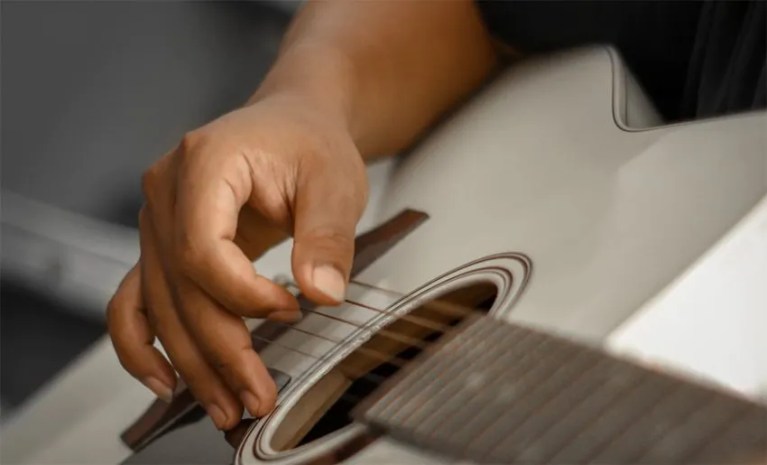
"House of the Rising Sun" is surprisingly easy and fun to play on guitar. Learn a basic picking pattern and get rocking!

Here is a simple version of "Darling Corey" using two chords, A and G, that will give you plenty of practice switching between those two chords.
ADVERTISEMENT
When switching between some chords, like A and D, you are able to pivot around the index finger, holding it down while you move your other fingers around it.
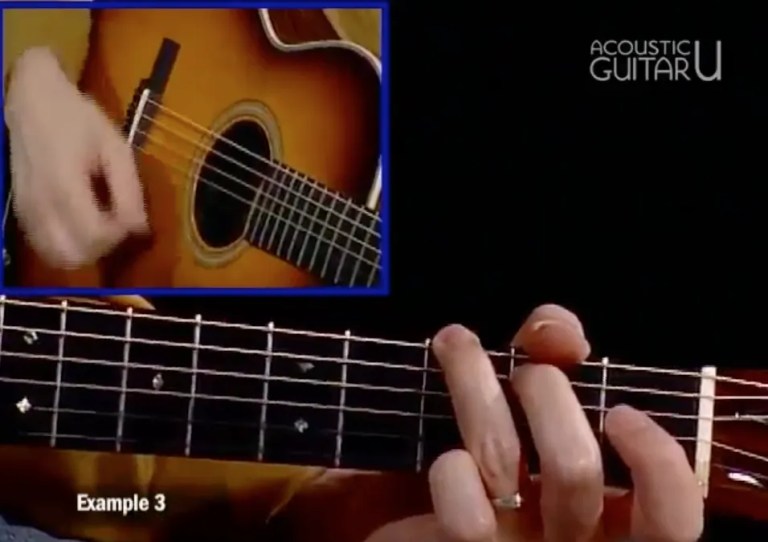
So here it is, our first bass/strum move. It’s not so different from doing four straight downstroke strums, except that the first strum is replaced with a single note, the root of the chord.

The G7 chord, as you might guess, is closely related to G...
ADVERTISEMENT
Learn how to employ this classic blues technique with this excerpt from Acoustic Guitar Slide Basics

Thumping out a steady bass drone with your thumb lets you spin bluesy, single-note licks over the top with your fingers as an improvised alternative to the folkier-sounding alternating-bass style.
My initial exposure to this tune was through the version by Django Reinhardt, Stéphane Grappelli, and the Quintet of the Hot Club of France.
ADVERTISEMENT
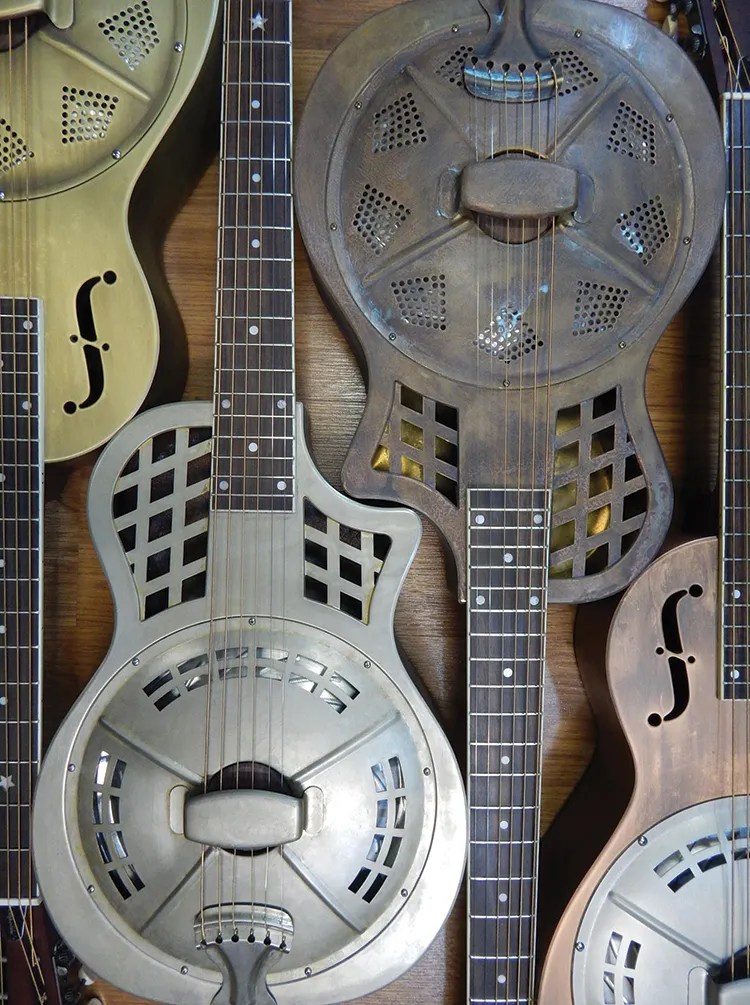
Republic Guitars has caught the attention of the late Texas blues legend Johnny Winter, as well as members of the Eagles and the Doobie Brothers.

